A Cape buffalo gives you very little margin. Place the first shot in the right pocket of vital tissue and the hunt is almost over; place it an inch off and the next hour can be long and dangerous. This guide is how we hunt buffalo at Marula Game — fair chase, off the sticks, with a premium for the well-judged bull and the clean first shot.
If you're planning Cape buffalo hunting in South Africa, the shot-placement briefing is the same one we give every hunter before stepping into the bush.
The vital triangle
On a buffalo standing broadside, picture a triangle. Its back edge is the line behind the front leg. Its bottom is the line of the brisket. Its third side runs from the top of the shoulder diagonally down to the elbow. Inside that triangle sit the heart, the bottom of both lungs and the great vessels above them. That is the vital triangle, and it is what you are aiming for on every broadside or quartering shot.
The broadside shot
The textbook buffalo shot is broadside, both front legs visible, the bull calm or just stopped. Run a vertical line straight up the back of the front leg and put the bullet a third of the way up the body on that line. That is heart and the lower lobes of both lungs. A premium bonded or monolithic expanding bullet through that pocket is decisive, even on a 800-kilogram bull.
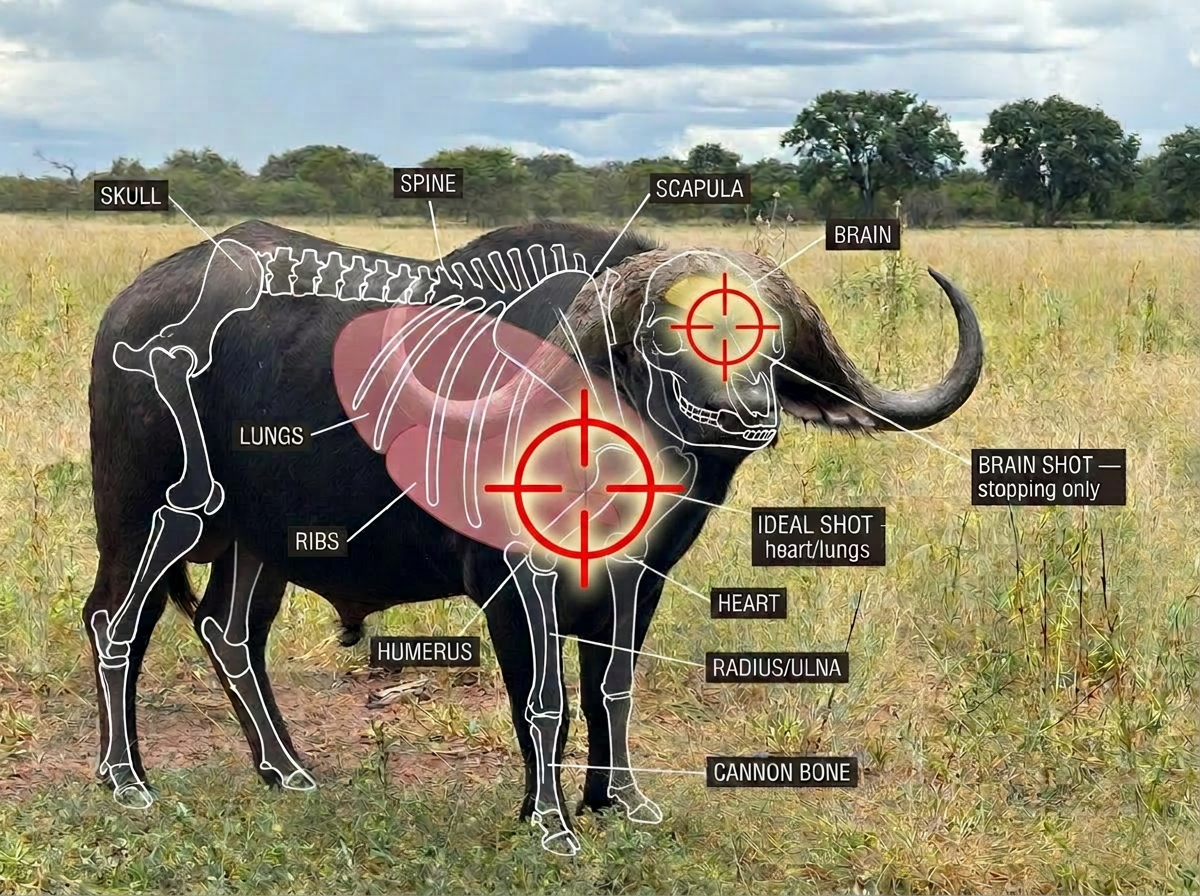
A common mistake is to shoot too high — the buffalo's spine sits lower than the line of the back, and a high shot can pass over the lungs entirely. Aim low into the triangle, not for the middle of the body.
The quartering-on shot
When the bull stands quartering towards you, the on-side shoulder hides part of the vitals. Pick the point of the on-side shoulder and angle the bullet to exit behind the off-side front leg. With the right rifle and a solid follow-up, this is a clean shot, but it asks more of the bullet — bone first, then deep penetration through to the off-side lung. Save quartering shots for hunters and rifles that can handle them.
The frontal shot
A frontal shot is ethical on a calm, square-on bull with the right rifle. Aim at the centre of the chest, level with the point of the shoulder — essentially at the small dip at the base of the neck. The bullet drives through the heart-lung area and stops the bull straight down. If the bull's head is up and the brisket is exposed, this is a fast, decisive shot. If the head is low or the body angled, wait.
Brain and spine — emergency shots only
The brain shot on a buffalo is small, well protected by the boss, and shifts as the head moves. We do not use it as a first shot. It is a stopping shot — the one your PH may take if a wounded bull turns on the party. Likewise the spine: a useful follow-up on a moving or going-away bull, never the planned first round.
The texas-heart-shot and other angles to refuse
A buffalo walking straight away from you is not a buffalo to shoot. So is a buffalo with cows or calves between it and your rifle, a bull silhouetted on a skyline you can't see past, or any shot you would not take if a witness were standing next to you. Fair-chase ethics aren't a slogan; on dangerous game they are how everyone gets home.
Follow-up shots: the rule is keep shooting
A well-hit buffalo can run a hundred metres and stand looking perfectly alive. The discipline is to keep working the rifle until the bull is down and still. Reload as you walk, watch the tail (a tail held straight down is often a dying bull, a flicking tail is a fighting one) and be ready to anchor with a solid through the spine or shoulder. Your PH will call the follow-up shots; trust the call and shoot when told.
Rifle calibre & bullet selection for buffalo →
Judging a mature bull in the field
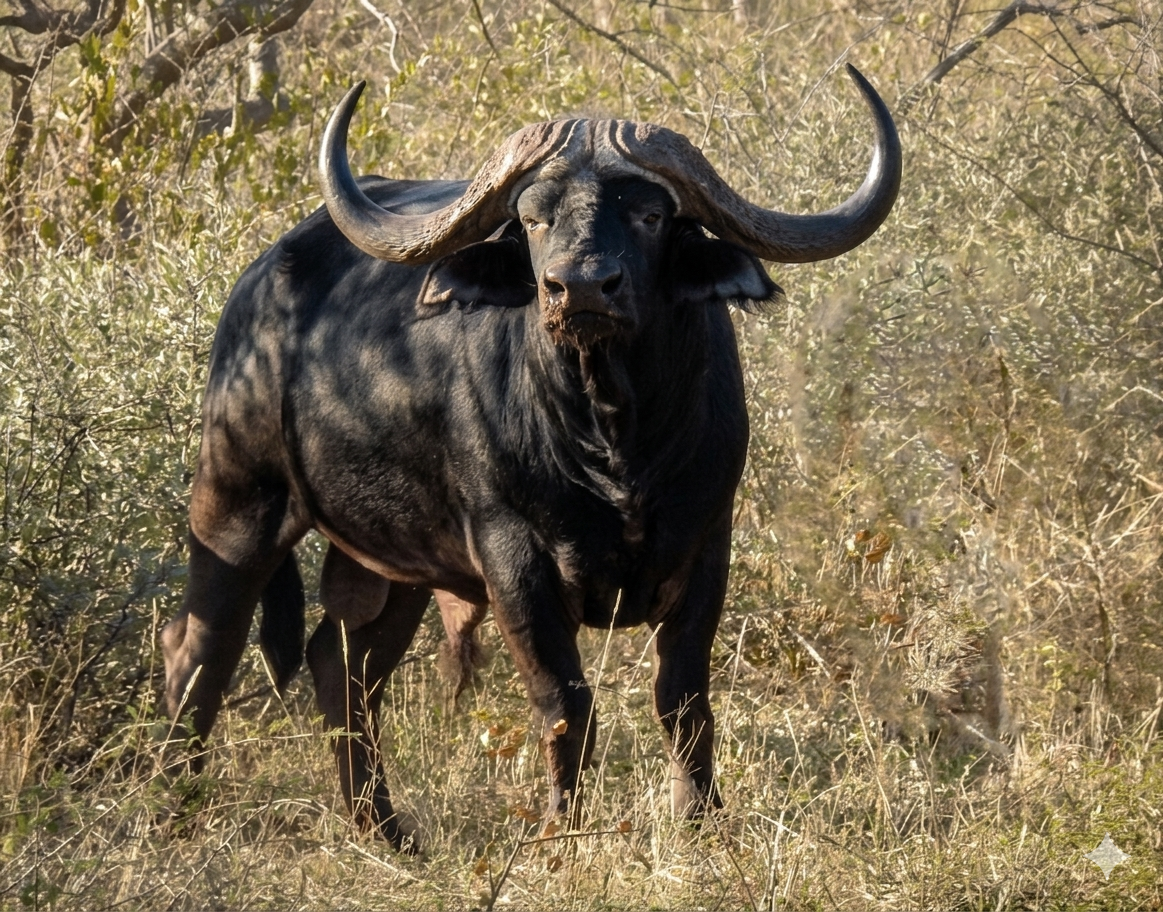
Trophy quality on Cape buffalo is read off the boss first, the body second and the spread last. We hunt old, hard-bossed bulls — animals past their breeding peak. Spread is the easy thing to see in a photograph, but it is not what makes a great buffalo bull.
The boss
- • Hard and polished: on a mature bull the boss is solid keratin, smooth and shiny, with no soft tissue or hair between the horns.
- • Worn tips: the horn tips are blunted and chipped from years of feeding and fighting, not sharp and pointed.
- • Heavy drops: the horns drop deeply below the level of the boss before sweeping out and up.
- • No hair between the horns: a clear, hard centre boss is the single best sign of an old bull.
The body and behaviour
- • Heavy, deep body with a sagging belly and prominent dewlap
- • Thick, dark, almost black neck and shoulders — bald patches on the body are common
- • Often found alone or with one or two other old bulls (a dagga boy), pushed out of the breeding herd
- • Slow, measured walk; less skittish, more confrontational than younger animals
Spread — the last thing to look at
Tip-to-tip spread is what people photograph, but a wide-horned soft-bossed bull is a young animal taken too early. A 38-inch bull with a worn, polished boss is a far better trophy than a 44-inch bull whose horns still have hair in the centre. We judge boss first.
How a buffalo hunt actually unfolds at Marula
We track on foot, off the vehicle. Chris Burger and his trackers read sign — pad prints, fresh dung, broken branches — and the day usually ends close to a bull. Shots typically come inside 40 metres, off sticks or freehand, in thornveld where everything happens fast. The preparation that pays back is range time from field positions and a clear, calm picture of the vital triangle before you ever step into the bush.
FAQs — shot placement & field judging
Where do you shoot a Cape buffalo?
On a broadside bull, aim for the lower third of the body, straight up the front leg — heart and the bottom of both lungs, the centre of the vital triangle.
What is the vital triangle?
The area bounded by the back of the front leg, the bottom of the chest and a line up through the top of the shoulder — heart, lungs and great vessels all sit inside it.
How do you judge a mature bull?
Hard polished boss, no hair between the horns, deep drops, worn tips, heavy dark body. Spread is secondary.
How many shots should you plan for?
More than one. Keep shooting until the bull is down and still — first round expanding, follow-ups with solids.
Is a frontal shot ethical?
Yes, on a calm bull facing you square, with the right rifle. Aim centre of chest, level with the point of the shoulder. A broadside shot is preferable when offered.