Free-range spiral-horn · from $4,250
Greater Kudu Hunting in South Africa
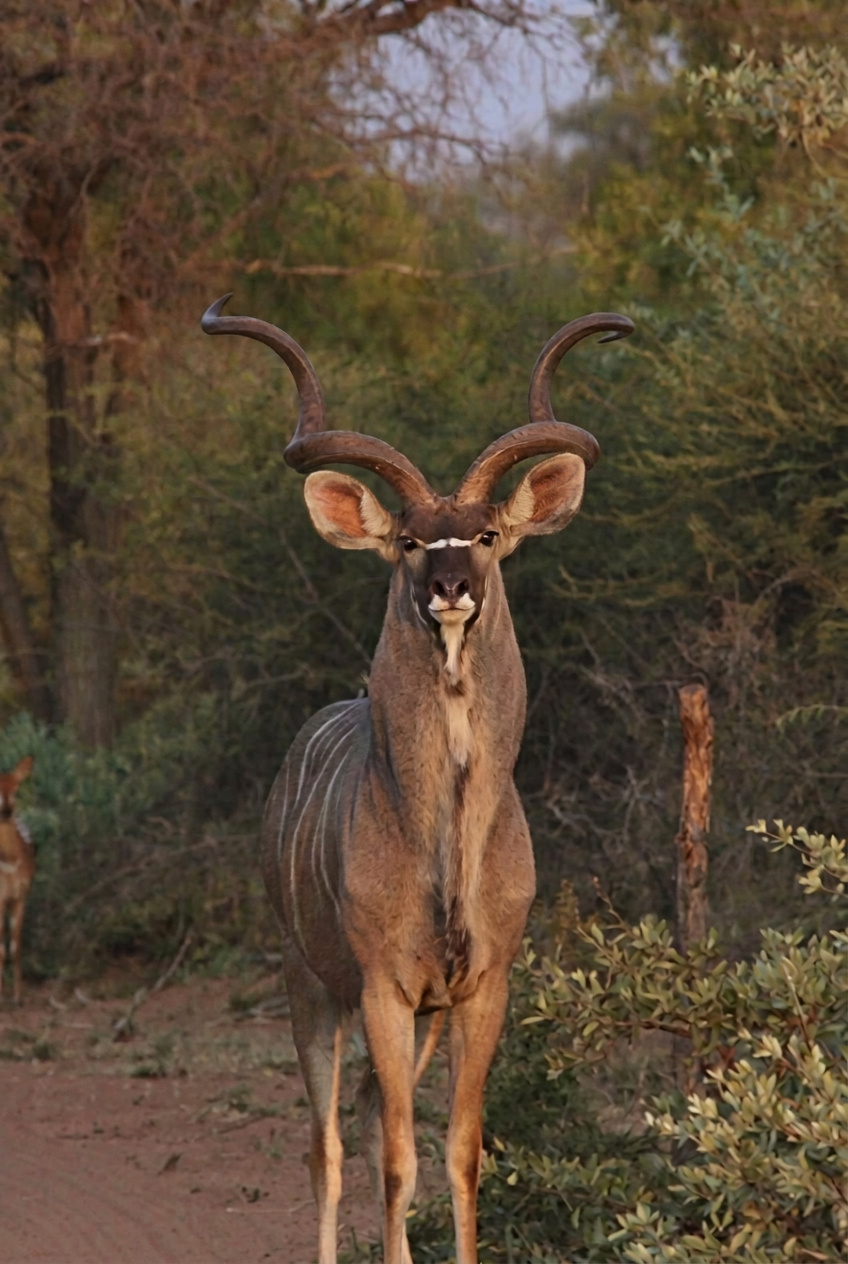
Greater kudu hunting is, for most hunters, the reason they came to Africa in the first place. Grey-flanked, white-striped, with those long spiralled horns rising out of the Bushveld — the "grey ghost" is the most sought-after spiral-horn on the continent, and the trophy that defines a first African safari. At Marula Game we hunt free-range kudu on 24,700 acres of mixed Bushveld in malaria-free Limpopo, fair chase on foot with a licensed PHASA Professional Hunter. Trophy fees start at USD $4,250 for a mature bull.
Greater Kudu · trophy fees (USD)
from $4,250 USD
- Greater Kudu bull, under 55" — $4,250
- Greater Kudu bull, 55–59" — $5,500
- Greater Kudu bull, 60" and above — POA
Trophy fees are payable only on animals taken (or wounded). Plains-game daily rates from $400–$500 per hunter per day, all-inclusive.
Included
- ✓ Lodge accommodation & all meals
- ✓ Licensed PH, tracker & skinner
- ✓ 4×4 vehicle & field prep
- ✓ Airport transfers & hunting permits
Not included
- – International flights
- – Trophy fees (payable on animals taken)
- – Dip-and-pack, shipping & taxidermy
- – Gratuities
The grey ghost of the Bushveld
Kudu earned their nickname honestly. A mature bull will stand nose to the wind on a rocky rise at first light and be gone the moment your boot crunches gravel — one soundless bound over the thorn and he has dissolved into grey shadow. They are a big antelope — 250 kilograms on the hoof, standing taller at the shoulder than a man — and yet they move through thick Bushveld the way smoke moves through a room. That contradiction, and the shape of those triple-curl horns coming through the leadwoods, is why hunters keep coming back for one more kudu.
Why hunt greater kudu at Marula
- Free-range on our own ground. Kudu at Marula are wild, born on the property, and hunted on foot across 24,700 acres of mixed Bushveld — no put-and-take, no released animals.
- Your own farm and camp. Our farms are separate, each with its own private camp — your party hunts its own ground with a dedicated PH, never shared with another group.
- Mature trophy bulls. Property average sits in the low-50s with better bulls reaching 55–59 inches and exceptional bulls beyond 60. Age and horn mass are prized ahead of raw length.
- Owner-hosted since 1997. Every safari is personally hosted by outfitter Chris Burger — PHASA Executive Committee member and WRSA Game Farmer & Game Breeder of the Year.
- Malaria-free. The Waterberg / Limpopo Valley is one of the few African hunting destinations you can safely bring family into without prophylaxis.
The hunt itself
Kudu hunting at Marula is classic walk-and-stalk in the mixed Bushveld. First light usually finds you glassing off a rocky outcrop or koppie into the drainage lines where kudu feed and water. Once a bull is spotted the stalk begins — quartering the wind, using the leadwood and marula stands as cover, closing the last hundred metres slowly. Shots are typically taken between 60 and 150 metres from sticks. A steady rifle in .270 through .30-06 is more than enough medicine for kudu; a well-placed premium soft-point in the shoulder ends the argument quickly. Plan on two to three hunting days per bull if you are holding out for something mature.
Best time of year to hunt greater kudu
The South African hunting season runs April to September. For greater kudu the prime window is the dry winter months — roughly May through August — when the Bushveld thins out, waterholes concentrate movement, and the kudu rut brings old bulls out of the thick country in search of cows. The rut typically peaks in May and June, and it is the one time of year an old bull who has lived long by staying hidden will risk daylight to follow a hot cow — which is exactly when you want to be on the ground. Cooler mornings also make for longer, more comfortable stalks.
Greater kudu hunt price (USD)
The greater kudu hunt price at Marula starts at USD $4,250 trophy fee for a mature bull under 55 inches, USD $5,500 for a bull of 55–59 inches, and bulls of 60 inches and above are priced on application. Trophy fees are payable only on animals taken (or wounded). Daily rates are two-tier and all-inclusive — plains-game hunts USD $400–$500 per hunter per day from the standard lodges (Tents on Antwerp $400, Leadwood/Haakdoring $450, Marula Lodge $500), and Cape buffalo hunted 1×1 from the sole-occupancy Buffalo Tented Camp at USD $1,000 per hunter per day. Daily rates cover accommodation, meals, licensed PH, tracker & skinner, 4×4, airport transfers and field prep. Kudu pair naturally with a wider plains-game safari or add on to a Cape buffalo hunt for a full dangerous-game and spiral-horn experience.
Full pricelist · USD
Get the full kudu & Marula pricelist
Every kudu class, daily rates and combo pricing in USD — sent to your inbox in seconds.
What's included
- ✓ Exclusive-use luxury lodge or tented camp
- ✓ All meals and beverages (in moderation)
- ✓ Licensed PHASA Professional Hunter, tracker & skinner
- ✓ 4×4 hunting vehicle, field prep and delivery to taxidermist
- ✓ Airport transfers from Johannesburg (JNB) or Polokwane
- ✓ Firearm import assistance and all hunting permits
Greater kudu hunting FAQs
How much does a greater kudu hunt cost in 2026?
Greater kudu hunt price starts at USD $4,250 trophy fee for a mature bull under 55 inches, USD $5,500 for a 55–59 inch bull, and exceptional bulls of 60 inches and beyond are priced on application. Plains-game daily rates are all-inclusive from USD $400–$500 per hunter per day, covering lodge accommodation, all meals, licensed Professional Hunter, tracker & skinner, 4×4 hunting vehicle and airport transfers.
What is a typical greater kudu trophy size in inches?
Mature Marula greater kudu bulls generally measure 50 to 55 inches along the outer curve of the horn, with better bulls reaching 55–59 inches and exceptional trophies breaking 60 inches. Horn shape and curl count matter as much as raw length — a heavy, deep-curled bull with three-and-a-half turns is a trophy of a lifetime at any measurement.
When is the best time to hunt greater kudu in Limpopo?
The South African hunting season runs April to September, and greater kudu hunt best in the dry winter months — roughly May through August. Bushveld leaves are down, waterholes concentrate movement, and old bulls come out of hiding during the rut (typically May–June), moving in daylight to seek cows. Cooler mornings also make for longer, more comfortable stalks.
Can I import a greater kudu trophy to the USA?
Yes. Greater kudu is not CITES-listed, so import into the United States is straightforward — no CITES permit required, only the standard USFWS 3-177 declaration and a South African export permit. Your dip-and-pack facility handles the paperwork on your behalf.
What calibre do I need for greater kudu?
For greater kudu, a flat-shooting rifle in .30-06 through .300 Win Mag with premium bonded or monolithic bullets is right. Your PH will go through shot placement with you before the hunt. If you add a Cape buffalo, the legal minimum for dangerous game is .375 H&H.
Do I need a hunting licence or permit?
You do not need to buy a separate hunting licence. Marula Game arranges all hunting permits for your greater kudu hunt as part of the daily rate. If you bring your own rifle you need a SAPS 520 temporary firearm import permit, which we help you complete; hunting with one of our camp rifles avoids this.
Can I combine a kudu hunt with a Cape buffalo hunt?
Yes. Greater kudu pairs naturally with a Cape buffalo hunt on the same trip. Cape buffalo is hunted 1×1 from the sole-occupancy Buffalo Tented Camp at $1,000 per hunter per day, with trophy fees on a sliding scale from $11,500 for a bull under 42". See our Cape buffalo hunting page or the safari packages page for ready-made combinations.
See also our guide to importing trophies to the USA.
Cross-shop the other spiral-horn hunts on the property — sable antelope hunting and Cape buffalo.
Guest Reviews
What our guests say
Unedited entries from our visitors' book. Names shown as initials to protect our guests' privacy.
“Thank you so much for hosting us on this hunt. This has become my home away from home a number of times, and if you'll have me, I hope to come even more times in the future!”
“WOW — I have a new family. Every day a warm smile. I learnt so much about South Africa. Can't wait to save up to come back. Thank you Marula family!”
“Overwhelmed with daily love and accepted with open arms. Not one day without a smile. This place is like a paradise that you never want to leave.”
“Uniquely spectacular! Wow! This was truly a trip of a lifetime. We felt welcomed, cared for and definitely pampered. The rustic elegance of this setting is beyond compare. The hunting was beyond our expectations.”
“From the moment we were picked up from the airport to the very last day, we were treated like royalty. The friendships forged will last a lifetime. The memories are a gift we will cherish forever.”
“My 3rd trip here. Good honest people, awesome experience — and I never shot an animal!”
Plan the rest of your safari