Cape buffalo are built to absorb punishment. A bull can weigh 800 kilograms, carries a heavy boss of horn over a thick skull, and is famous for circling back on whatever is following it. Bringing the wrong rifle is not a small mistake — it is the mistake. This guide covers the calibres that work, the bullets that matter, and the gear that earns its place on a buffalo hunt. If you're planning Cape buffalo hunting at Marula, this is the same rifle brief we give every hunter before the season.
The legal minimum: .375
South African regulation and long-standing ethics set the floor at .375 calibre for Cape buffalo. This is not red tape — it reflects hard-won field experience about what reliably stops a dangerous animal. Below .375 you simply may not hunt buffalo here, and you would not want to.
The classic choice: .375 H&H Magnum
If one calibre defines African dangerous-game hunting, it is the .375 H&H Magnum. It meets the legal minimum, is widely available, recoils within reach of most hunters who practise, and has cleanly taken every animal on the continent for over a century.
For a hunter coming for buffalo and plains game on the same trip, the .375 H&H is the most versatile single rifle you can carry — enough for buffalo, not too much for kudu.
What we use at Marula Game
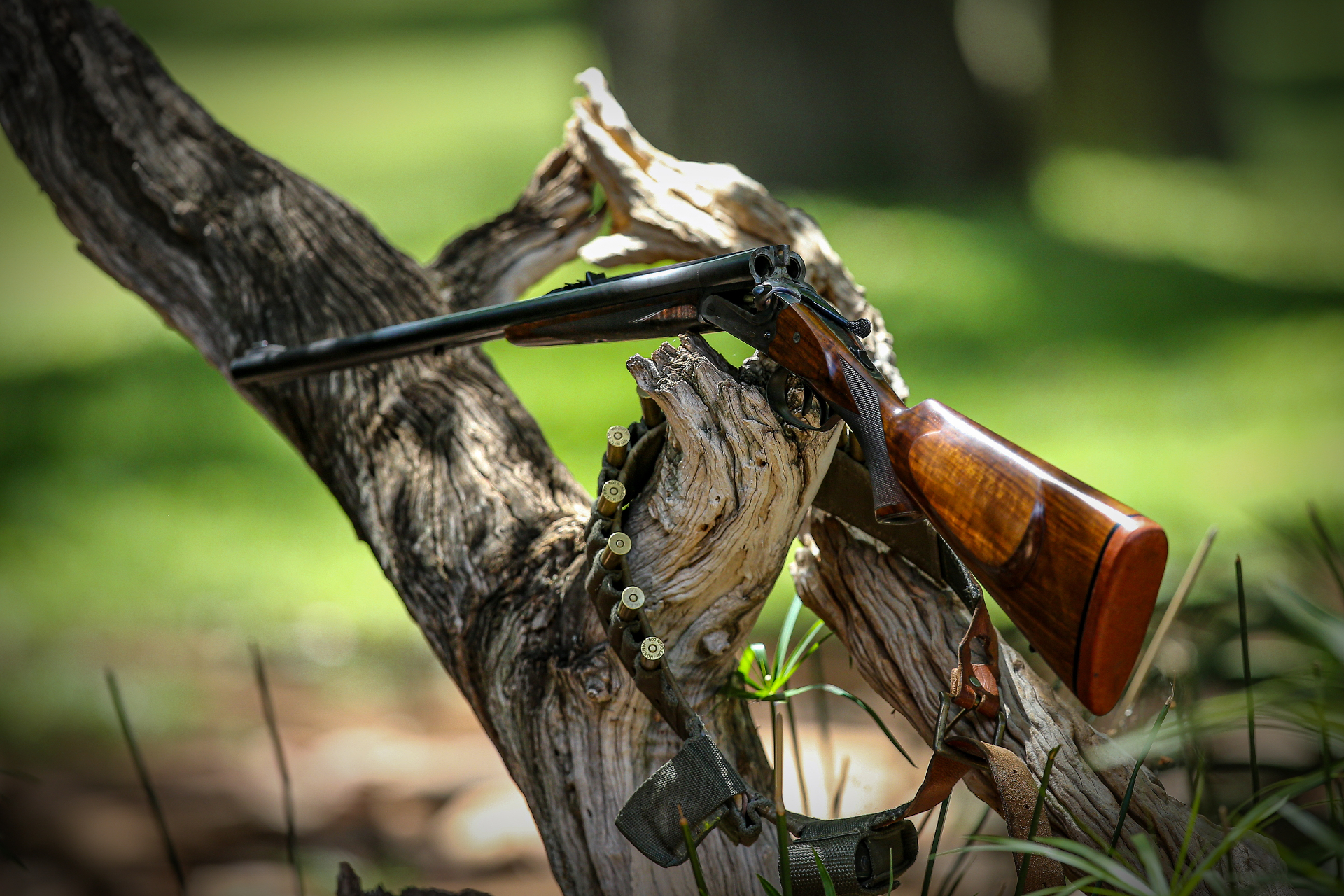
At Marula Game we carry three calibres for guided buffalo hunts: the .375 H&H Magnum, the .458 Winchester Magnum, and the .500 Nitro Express. Each has its place depending on the hunter, the terrain, and the shot distance expected.
Chris's personal favourite is the .458 Winchester Classic Express — a stopping rifle with the authority to anchor a buffalo in thick bush and the balance to swing fast when things happen at close range. It is the calibre he reaches for when the track leads into dense thornveld.
Stepping up: the .40s and beyond
Plenty of experienced buffalo hunters prefer more than the minimum. Calibres like the .416 Rigby and .416 Remington Magnum hit harder and are superb buffalo medicine for those who can shoot them well. Beyond that sit the big bores — .458 Lott, .470 Nitro Express and similar — favoured in heavy cover and by hunters who want maximum stopping power. The catch is recoil: a big bore you flinch with is worse than a .375 you shoot straight.
The honest rule: bring the largest calibre you can shoot accurately and confidently from field positions — and not one inch more.
Bullets matter as much as calibre
On buffalo, bullet construction is half the game. The standard approach is a premium expanding bullet for the first shot into the vitals, backed by solids (non-expanding, full-metal-jacket) for follow-up shots that may have to drive through heavy bone or angle through the body. Bonded and monolithic premium bullets from the well-known dangerous-game makers are what to load — not standard soft-points.
- • First shot: premium bonded or monolithic expanding bullet
- • Follow-ups: solids for deep, straight-line penetration
- • Bring more ammunition than you think you need, all from the same box/lot you sighted in with
Optics: low power, fast, rugged
Buffalo are shot close — often inside 40 metres. You want a low-magnification scope with a wide field of view that you can get on target instantly, or a scope on quick-detach mounts so you can drop to open sights in thick cover. A 1–6x or 1.5–5x variable is ideal. A huge, high-magnification scope is the wrong tool for a charge at twenty paces.
- • Scope: 1–6x or 1.5–5x, illuminated reticle helps in low light
- • Quick-detach mounts so you can revert to iron sights
- • Turrets, mounts and rings checked and locked tight before you travel
Sight in before you fly
Arrive with a rifle you have already sighted in and shot from sticks, kneeling and offhand — not just off a bench. We will confirm zero on the range when you arrive, but the practice has to happen at home. The single best thing you can do to prepare for a buffalo hunt is to put rounds downrange from realistic field positions until the rifle feels like part of you.
The rest of the buffalo kit
- • A sturdy sling and a cartridge belt or stock cuff for fast reloads
- • Quality binoculars for picking bosses and bulls out of a herd
- • Quiet, broken-in boots — buffalo hunts are walking hunts
- • Shooting sticks (your PH will have them; bring your own if you prefer)
- • Ear protection for the range, and the discipline to leave it off in the field
Can't or won't travel with a rifle?
Flying with a firearm internationally is straightforward with the right paperwork, but some hunters would rather not. Borrowing a properly set-up dangerous-game rifle in camp removes the airline hassle entirely — and means you arrive to a rifle that is already zeroed and proven on buffalo.
Cape buffalo rifle and gear — FAQs
What is the minimum calibre for Cape buffalo in South Africa?
By law, .375 calibre is the minimum permitted for Cape buffalo.
Is a .375 H&H enough for buffalo?
Yes — the .375 H&H Magnum is the classic, proven choice and is enough for buffalo while remaining versatile for plains game.
What bullets should I use on buffalo?
A premium bonded or monolithic expanding bullet for the first shot, backed by solids for follow-ups.
What scope is best for buffalo?
A low-power variable such as 1–6x with a wide field of view, ideally on quick-detach mounts so you can use iron sights in thick cover.
Can I hire a rifle instead of flying with mine?
Rifle hire may be available in camp — ask when you book, as it removes all airline firearm paperwork.