Free-range spiral-horn · from $2,900
Nyala Hunting in South Africa
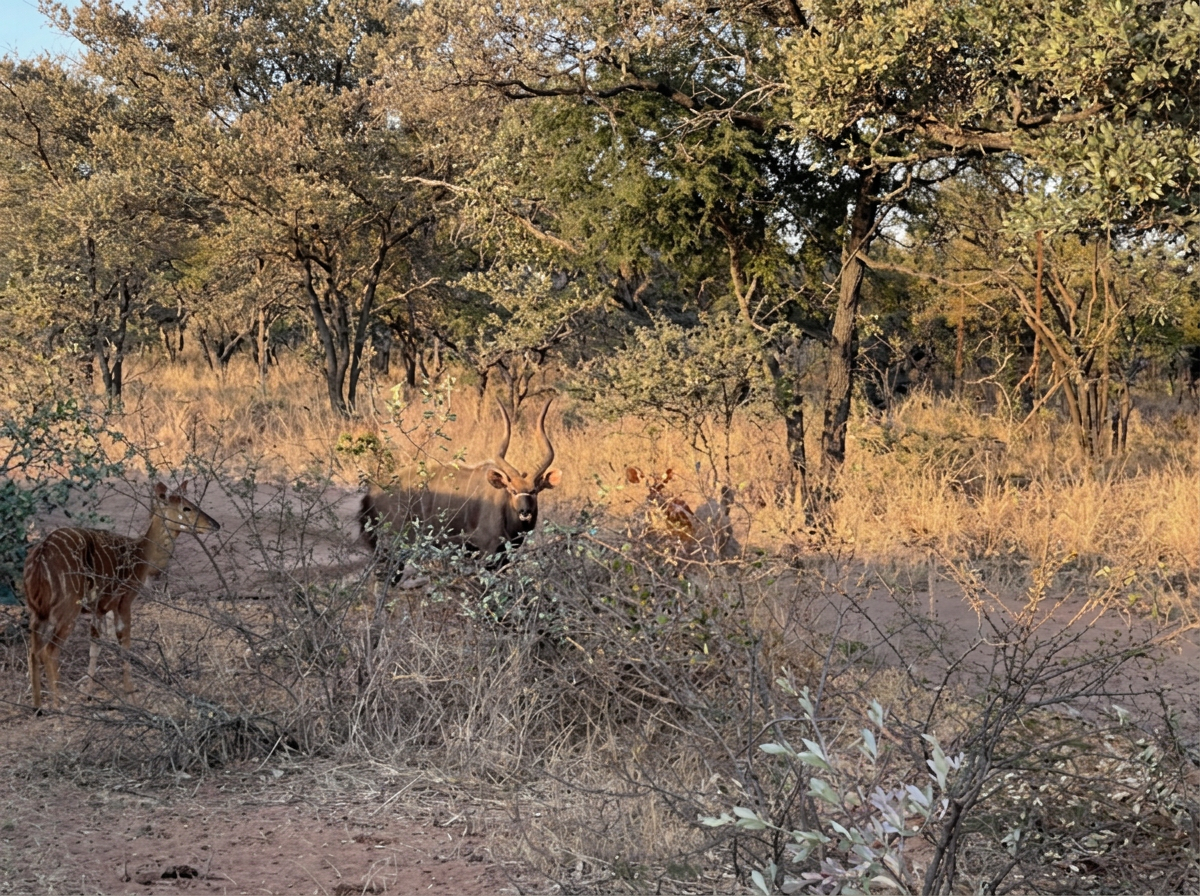
Nyala is the shy prince of the Limpopo Bushveld — a slate-grey, spiral-horned antelope that lives in the thickest riverine cover on the property and rarely offers a second chance. Bulls carry a full shaggy mane down the spine, chalk-white vertical stripes across a dark coat, and lyre-shaped horns tipped in ivory. Nyala are a Limpopo speciality — genuinely at the southern edge of their range — and one of the most beautiful trophies in Africa. At Marula Game we hunt free-range nyala on 24,700 acres of mixed Bushveld in malaria-free Limpopo, fair chase on foot with a licensed PHASA Professional Hunter. Trophy fees start at USD $2,900.
Nyala · trophy fees (USD)
from $2,900 USD
- Nyala bull, representative mature — $2,900
- Nyala bull, exceptional (29"+) — POA
Trophy fees are payable only on animals taken (or wounded). Plains-game daily rates from $400–$500 per hunter per day, all-inclusive.
Included
- ✓ Lodge accommodation & all meals
- ✓ Licensed PH, tracker & skinner
- ✓ 4×4 vehicle & field prep
- ✓ Airport transfers & hunting permits
Not included
- – International flights
- – Trophy fees (payable on animals taken)
- – Dip-and-pack, shipping & taxidermy
- – Gratuities
The prince of the thick bush
Where kudu will stand on a rise and read the wind, nyala stay tight to the river and the densest cover on the property. They feed at first light and last light, and they slip back into the leadwood and jackalberry thickets long before the sun is up. An old bull is one of the darkest antelope in Africa — almost charcoal in the shade — with a full crest of hair standing along the spine and a ridge of white chevron between the eyes. Get one broadside in a shaft of morning light and you'll understand why hunters cross oceans for a nyala.
Why hunt nyala at Marula
- Free-range on our own ground. Nyala at Marula are wild, born on the property, and hunted on foot in the riverine thickets — no put-and-take, no released animals.
- Your own farm and camp. Our farms are separate, each with its own private camp — your party hunts its own ground with a dedicated PH, never shared with another group.
- A Limpopo speciality. Nyala reach their southern-range limit in this part of South Africa — the Waterberg / Limpopo Valley is genuine nyala country, not a translocated population.
- Owner-hosted since 1997. Every safari is personally hosted by outfitter Chris Burger — PHASA Executive Committee member and WRSA Game Farmer & Game Breeder of the Year.
- Malaria-free. One of the few African hunting destinations you can safely bring family into without prophylaxis.
The hunt itself
Nyala hunting at Marula is close-cover walk-and-stalk. First light usually finds you easing along a game path in the riverine bush, wind in your face, listening for the soft alarm-bark of a cow or the crack of a bull moving off feed. Sightings are quick and often close — 40 to 100 metres from sticks in broken cover. A steady rifle in .270 through .30-06 with a premium soft-point behind the shoulder is ideal medicine. Plan on two to three hunting days per bull if you are holding out for something mature and dark.
Best time of year to hunt nyala
The South African hunting season runs April to September. For nyala the prime window is the dry winter months — May through August — when the riverine bush thins slightly, waterholes concentrate movement, and mature bulls come to feed morning and evening in the open edges. Cooler mornings mean longer, quieter stalks and more time in the field before the heat pushes animals into shade.
Nyala hunt price (USD)
The nyala hunt price at Marula starts at USD $2,900 trophy fee for a representative mature bull. Trophy fees are payable only on animals taken (or wounded). Daily rates are two-tier and all-inclusive — plains-game hunts USD $400–$500 per hunter per day from the standard lodges (Tents on Antwerp $400, Leadwood/Haakdoring $450, Marula Lodge $500). Daily rates cover accommodation, meals, licensed PH, tracker & skinner, 4×4, airport transfers and field prep. Nyala pair naturally with a wider plains-game safari or add on to a greater kudu hunt for a two-spiral-horn Limpopo package.
Full pricelist · USD
Get the full nyala & Marula pricelist
Every plains-game species, daily rates and combo pricing in USD — sent to your inbox in seconds.
What's included
- ✓ Exclusive-use luxury lodge or tented camp
- ✓ All meals and beverages (in moderation)
- ✓ Licensed PHASA Professional Hunter, tracker & skinner
- ✓ 4×4 hunting vehicle, field prep and delivery to taxidermist
- ✓ Airport transfers from Johannesburg (JNB) or Polokwane
- ✓ Firearm import assistance and all hunting permits
Nyala hunting FAQs
How much does a nyala hunt cost in 2026?
Nyala trophy fees at Marula start at USD $2,900 for a mature bull. Plains-game daily rates are all-inclusive from USD $400–$500 per hunter per day, covering lodge accommodation, all meals, licensed Professional Hunter, tracker & skinner, 4×4 hunting vehicle and airport transfers.
What does a good nyala trophy look like?
A representative mature nyala bull carries horns of 25–28 inches with good ivory tips, a full shaggy mane along the spine, and the striking slate-grey coat with white vertical body stripes. Exceptional bulls push past 29 inches. Age, mane development and horn shape matter as much as raw length — an old, dark, heavily-maned bull is a true trophy.
When is the best time to hunt nyala in Limpopo?
The South African hunting season runs April to September. Nyala hunt best in the dry winter months — May through August — when the riverine bush thins slightly, waterholes concentrate movement, and mature bulls come to feed morning and evening. Cooler mornings also make for longer, quieter stalks in thick cover.
Can I import a nyala trophy to the USA?
Yes. Nyala is not CITES-listed, so import into the United States is straightforward — no CITES permit required, only the standard USFWS 3-177 declaration and a South African export permit. Your dip-and-pack facility handles the paperwork on your behalf.
What calibre do I need for nyala?
For nyala, a flat-shooting rifle in .270 Win through .30-06 with premium bonded or monolithic bullets is right. Your PH will go through shot placement with you before the hunt. If you add a Cape buffalo, the legal minimum for dangerous game is .375 H&H.
Do I need a hunting licence or permit?
You do not need to buy a separate hunting licence. Marula Game arranges all hunting permits for your nyala hunt as part of the daily rate. If you bring your own rifle you need a SAPS 520 temporary firearm import permit, which we help you complete; hunting with one of our camp rifles avoids this.
Can I combine a nyala hunt with a Cape buffalo hunt?
Yes. Nyala pairs naturally with a Cape buffalo hunt on the same trip. Cape buffalo is hunted 1×1 from the sole-occupancy Buffalo Tented Camp at $1,000 per hunter per day, with trophy fees on a sliding scale from $11,500 for a bull under 42". See our Cape buffalo hunting page or the safari packages page for ready-made combinations.
See also our guide to importing trophies to the USA.
Plan the rest of your safari